Powered By Blogger
Showing posts with label lunar occultation. Show all posts

Friday, August 19, 2011

Occultation of Pi Sagittarii, August 10, 2011

Wednesday, August 10, was a work night, so I couldn’t make it to the Chicago Astronomer session. Besides, I wanted to observe the Pi Sagittarii occultation uninterrupted. Hillary wanted to see the occultation too, but the Moon was low, and she has tall trees behind her house. We went to Gilbert Park in Portage for an unobstructed, uninterrupted observation.

My plan was to document the immersion and emersion times through multiple telescopes and cameras. Without practice, though, nothing went according to plan. My 4.5” Newtonian is too badly out of collimation for useful observation at high magnification, but I wanted to use it. I figured I could run my Mead camera to my computer to help keep an eye on Pi Sagittarii while I was away from the eyepiece of my 6” Dob. That probably would have worked, but the batteries were almost dead, and the scope wasn’t tracking properly.

The plan for my Dob was to get pictures with one of my Logitech webcams, since the webcam images have a timestamp. I had forgotten that my testing of the webcam for lunar images hadn’t been good, and wasn’t getting quality images. As a last resort, I was forced to use my Vivitar point and shoot camera, without a timestamp for each image. Something is better than nothing.

As soon as I had the Dob ready to go around 8:30 PM CDST, I could see Pi Sagittarii already near the northeast lunar limb. Hillary could also see it with her 60mm shorty refractor. I didn’t have much time before Curt’s predicted immersio, and was spending more time trying to eliminate problems than observing. As Luna drew ever closer to Pi Sagittarii, I had to focus on getting whatever I could, and be ready to check the time as soon as the star disappeared behind the lunar limb. I had a small window open with a Cartes du Ciel time displayed in CDST, and UTC for my timings.


Photobucket

Photobucket

Photobucket

Webcam images. Not as good as I was hoping they would be.


Photobucket

Photobucket

Photobucket


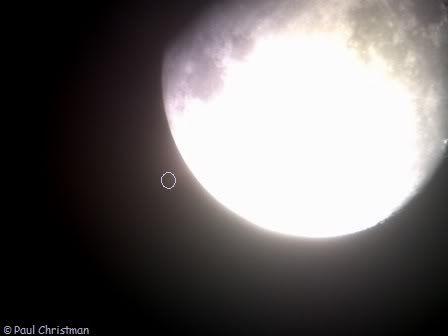
I was expecting immersion ahead of Curt’s predicted time, and really wanted to get a video of when the star disappeared. When the predicted time rolled around, the star was still visible. I was getting my camera ready for video, but wasn’t shooting yet when I couldn’t see Pi Sagittarii on the video screen anymore. I double checked at the eyepiece, and it was gone. The time was 8:53:50 PM CDST.  I took a few pictures of the Moon while the star was occulted, then shut down my computer to save battery, and enjoyed the last of my Dairy Queen chocolate shake.


Photobucket


Photobucket


Pi Sagittarii nearing the dark, leading lunar limb.


I had another set of batteries for my go-to Newt in my astronomy case, but they too were dead, and that scope was rendered useless the rest of the observation. I didn’t do much observing throughout the occultation, and just kind of hung out with Hillary until the emersion time approached. The emersion was behind schedule, and I was diligently watching through my 25mm eyepiece, waiting. I picked it out immediately, and noted the time (on the back of my hand) as 9:51:04 PM CDST. My first sets of images after emersion weren’t very successful, but as the Moon moved further from it, Pi Sagitarii became increasingly easier to capture out of the lunar glare. After only a few minutes of watching the two separate, it was time to pack up, take Hillary home, and go to work.


Photobucket


I thought I was well prepared for a great observation.


Photobucket


Photobucket


Hillary waiting for Pi Sagittarii to emerge from behind the Moon.


Photobucket


Photobucket


Luna during the occultation.


Photobucket


Pi Sagittarii just after emersion.


Photobucket


Photobucket


Photobucket


Photobucket


Photobucket


This was the third time I’ve caught at least part of a lunar occultation. I’ve also timed transits and shadow transits of the Galilean Moons in the Jovian system. I haven’t documented any of them as well as I would like to, but they are all learning experiences. I use these events to help train myself for the BIG ONE, next year’s transit of Venus across the face of the Sun. I’d like to gather scientifically useful data that can be used to measure solar parallax during that event, according to the method of French astronomer Delisle. I think I can do it, and every time I document a lunar occultation or Galilean transit, I hone my skills and methods for that last chance at the Venus transit.

Thursday, November 25, 2010

Failed Attempt at Mu Geminorum Occultation

I will edit this into a proper post tomorrow, but for now click on the title for the Chicago Astronomer thread.


Happy Thanksgiving!


I’d been looking forward to last Wednesday morning’s lunar occultation of Mu Geminorum almost since the last time it was occulted on October 27. Weather hadn’t cooperated with me well for that occasion, but I was able to catch sight of the star not long after it emerged from behind the lunar disk. I fought a strong, cold breeze and scattered cloud cover that night. I was disappointed not to see the immersion point of the occultation, and hoped that my rematch on November 24 would be better.


There was really no preparation needed to observe the occultation, other than to review the event times posted by Curt Renz, although since they are calculated for the Adler Planetarium in Chicago, they won’t be accurate times for me at home, but are close enough to tell me when to pay attention. Curt’s listed time for the immersion was 5:24 AM Central Standard Time, and 6:34 for the emersion, just 16 minutes before sunrise. Being at the eastern edge of the Central Time Zone, the emersion would happen during morning twilight, so I wasn’t sure if I’d be able to observe it. It was worth a try though.

I skipped a clear evening sky Tuesday night to sleep, planning to get up and observe in the middle of the night. I woke up around 2:30 AM, and checked the radar and satellite images before getting out of bed. A system was moving in, but there was a chance it might stay just south of Valparaiso. Getting up to have a look out the back door, I was glad to walk into the dark kitchen and see a bright rectangular spot on the floor. The Moon was shining down at an angle through the skylight.

I got bundled up, went outside and set the telescopes up to acclimate to the cold. I wasn’t in much of a hurry, except to get back inside and out of the 21 degree temperature, and16 degree wind chill factor. I did admire a nice full 22 degree halo around the Moon, though. After getting the telescopes ready I went inside to make a pot of coffee and check the latest weather satellite images. It wasn’t looking good, really. I was concerned that Accuweather's satellite showed cloud cover moving into the area, although at that time it was only patchy clouds. It was a big system, but no rain, so I didn’t have to worry about the telescopes outside unattended. The weather system I was watching had an eye opening up as it crossed into Illinois, and it's path could have brought that clear spot over Valpo before emersion. The immersion, however, was almost definitely going to occur before the opening arrived.


Photobucket

Around 3:30 AM CST, the Moon had a gorgeous halo, but of course it doesn't show in the picture.

Just after 4 AM, the Moon and brighter stars were still visible. Even though the edge of the system had crossed all of Indiana, the clouds were acting more like haze or a slight fog than anything else. Central and southern Illinois were in the heart of the system, but it looked like the Chicago area and Northwest Indiana, would see portions of the occultation.


Photobucket


I was trying to stay out of the cold as much as possible, so I didn’t try to observe the Moon as it caught up to Mu Geminorum. In hindsight, I should have. By the time I was ready to face the cold around 5AM, the sky was completely clouding over. All the bright stars had disappeared, and the Moon was barely visible through them. I kept a vigil on the tracking of my go-to Newtonian, so that if sucker holes opened up, I would be able to take advantage immediately. Of course there were no sucker holes, but at 5:17 AM, only a thin haze covered the Moon. I looked just in case, since the occultation was to begin in about 7 minutes, but the haze was too thick for the starlight to shine through.

Photobucket


The Moon shrouded at 5:36 AM.


I missed the immersion, but stayed out in the cold hoping that I could observe the emersion around 6:34. I was constantly checking Accuweather for an update on the system moving through, but they did not update the satellite images after 5:32. I watched the clouds pass over the Moon, which also kept the wind at my back. Turning around, though, by 5:35 I noticed the clouds in the east turning a deep red hue, portending daylight’s imminent arrival, with still nearly an hour to go before Mu Geminorum would emerge.


Photobucket

Photobucket

Photobucket

Daybreak. 

Photobucket

6:30:15.

Photobucket

Photobucket

Photobucket

6:24:27.

Photobucket

6:35:20. This was the clearest point of the observation.

Photobucket

Photobucket

Photobucket

Photobucket

Photobucket

By 6:40the Moon was totally obscured.


By 6:30, though hidden by clouds, the Sun had been up almost forty minutes. I started observations again, however unlikely I would get decent results. The clearing in the system that I was waiting for had started closing as it crossed Illinois, and the entire front shifted north, socking in Valparaiso. We were out of the worst of it, teasing me with the Moon showing through the haze. In a way that was worse than being totally clouded out. I wasn’t going to give up when my target was still (sort of) visible. At 6:35, after Mu Geminorum should have emerged, the clouds eased up slightly, but not enough to reveal the star. After that it only got worse. The sky was getting too bright, my toes were totally frozen, and when I looked up at 6:40, the Moon had disappeared behind the clouds. It was time to pack it in and admit defeat.

So, given that the observation was unsuccessful, why go through the trouble of such a lengthy post? Mostly to prove that I didn’t sleep through it!